MASS SPECTROMETRY SYSTEM FOR THE
LEAKAGE CONTROL USED FOR MUONS DETECTORS FABRICATION IN THE ATLAS-CERN
EXPERIMENT - Leakage-Control
International partners:
- CERN – EU
- JINR Dubna -
RUSSIA
- INCD INOE 2000
Funding: Romanian
funds for involvement in the Joint Institute for Nuclear Research, Dubna,
Russia
Coordinator:
INOE 2000,
Romania, RO Project manager: Dr. Viorel Braic
OBJECTIVES
STAND FOR MDT DETECTORS
MANUFACTURING in JINR Dubna (Russia
The system of muon detectors in ATLAS-CERN consists of 400.000
tubes filled with a mixture of Ar (92%), CH4
(3%) and CO2 (5%) at an internal pressure of 2 atm.
A radio-frequency mass-spectrometry based leak detection system
(LDS) for the in-line checking of aluminum tubes and
detectors for MDT chambers mass production was developed and operated.
Leak Detection System (LDS) - designed to be used in the quality
checking to ensure that the lifetime of the system corresponds to the
requirements of the end-user. It fulfills the
specific requirements for mass production:
- short test
time (< 5 min.);
- leak rates
in the range: 10-4 - 10-7 mbar.l/s;
- minimum
flow rate yet detected is 10-8 mbar.l/s.
- accuracy of
10%;
- automated
operation;
- automatic
data acquisition and storage;
- simple
maintenance.
RESULTS
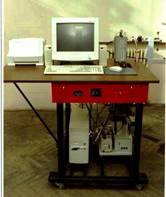
The leak detection stand consists of:
• mass
spectrometer gas analyzer consisting of
radio-frequency mass spectrometer (MS) type
RGA 100 (Stanford Research Systems) and vacuum system (VS);
• test bench
with Al tubes/detectors supports, including end connector devices for Al
tubes/detectors ;
• test gas
mixture (compressed air and He) preparation station;
• computer (PC),
control block (CB), accessories, and software.
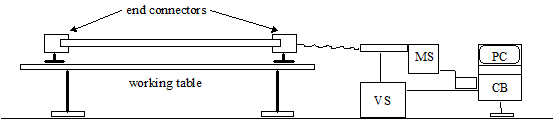
Block diagram of leak detection stand LDS
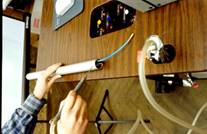
Automated procedure for the Al
tubes leak detection
1. put a tube on the bench;
2. assign a number for the tested tube in the
computer;
3. shift gently the tube in the immobile connector
and fasten it;
4. shift the blind connector over the other end of
the tube and fasten it;
5. press the TEST push button and an automatic
sequence starts. The START/STOP green
and red LEDs will flash till the pressure value at the entrance port of the
spectrometer reaches the level set before. Then the green LED remains lit.
6. spray He - air mixture on the external wall of
the tube (between the end connectors), using the test pistol;
7. the computer will display the partial pressure of
helium versus time. The operator has to decide the quality of the tested tube by
comparing the displayed level of helium partial pressure with the set level.
8. the operator has to write test data in the Leak_Data software.
9. when the test is finished, press the “TEST”
button. The LED “TEST” is lit and the red color
change to green colour.
10. press the air admission “AIR ADM” button to pressurize
the tube and loosen the end connectors.
Leak detection procedure for
chambers
The
chamber was tested after the detectors were assembled, assuming that the
detectors were not damaged during this operation. Only the end plugs and
plastic connectors will be tested.
The
detectors will be filled with the test gas mixture (air + 10% He) and the test
was carried out using the sniffer probe.
The
sniffer probe was connected to the test port of the mass spectrometer.
During
this test, the vacuum system including the mass spectrometer is maintained in
the “TEST” mode.